
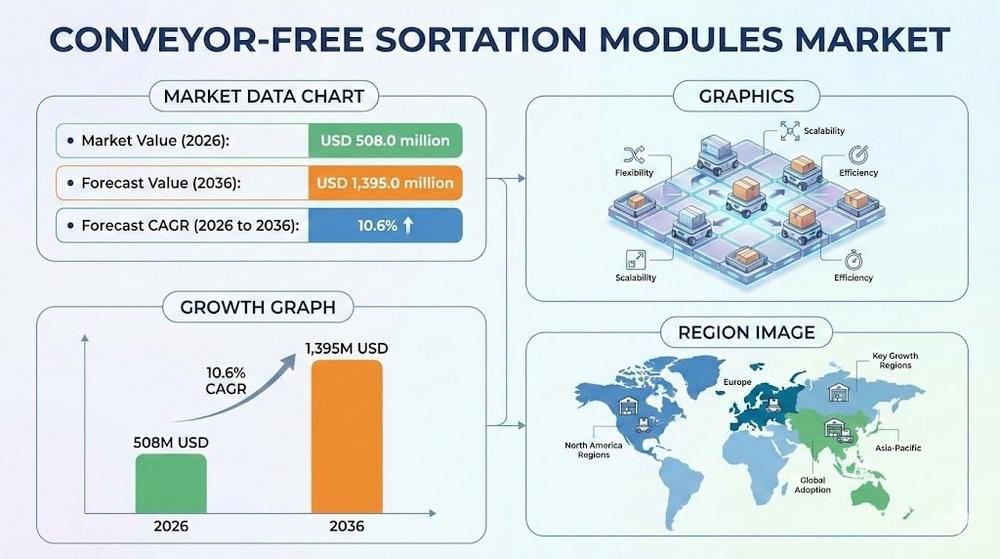
The global conveyor-free sortation modules market is entering a high-growth phase, driven by structural changes in logistics, fulfillment, and industrial material handling. Valued at USD 508 million in 2026, the market is projected to reach USD 1,395 million by 2036, expanding at a compound annual growth rate (CAGR) of 10.6% over the forecast period. This growth reflects a decisive shift away from fixed conveyor infrastructure toward modular, flexible sortation technologies that support modern fulfillment strategies.
Between 2026 and 2031, the market accelerates rapidly, supported by pilot deployments and phased integration into existing warehouses. Annual absolute value additions rise from approximately USD 51 million to USD 94 million, as operators validate throughput gains, space optimization, and automation reliability. From 2031 to 2036, expansion continues at scale, with broader deployment across logistics networks, parcel hubs, and industrial distribution centers, signaling a transition from early adoption to volume-led growth.
Subscribe for Year-Round Insights → Stay ahead with quarterly and annual data updates: https://www.futuremarketinsights.com/reports/sample/rep-gb-30199
Why Conveyor-Free Sortation Is Gaining Industry-Wide Attention
Traditional conveyor-based systems face inherent limitations related to floor space, rigidity, and high maintenance costs. Conveyor-free sortation modules address these constraints by enabling modular layouts, rapid reconfiguration, and distributed control. Early adopters, particularly in e-commerce fulfillment and third-party logistics, have demonstrated measurable improvements in throughput efficiency and operational flexibility.
According to industry analysts, “Conveyor-free sortation has moved beyond experimental automation. It is becoming a practical infrastructure choice for warehouses managing SKU diversity, seasonal peaks, and frequent layout changes.” These benefits are increasingly critical as fulfillment centers handle rising order volumes and tighter delivery timelines.
Key Growth Phases Through 2036
2026–2031: Early Acceleration Phase
- Market expands from USD 508 million to approximately USD 822 million
- Growth driven by pilot projects, selective retrofitting, and software maturity
- Adoption concentrated in high-volume logistics, retail distribution, and parcel sorting
2031–2036: Scaled Deployment Phase
- Market rises from USD 822 million to USD 1,395 million
- Conveyor-free modules become standard in new facility designs
- Repeat procurement across regional and multi-site distribution networks
While relative acceleration moderates slightly in the later years, absolute annual gains remain strong, reflecting deeper penetration and wider operational reliance.
End-Use Applications Driving Demand
Demand for conveyor-free sortation modules is closely tied to end-use operational requirements rather than uniform automation trends.
- E-commerce and distribution centers (≈55%) lead adoption due to fluctuating parcel volumes and space constraints
- Parcel and postal hubs rely on modular systems to manage peak-season variability
- Automotive component handling prioritizes accuracy and controlled movement
- Retail and last-mile hubs deploy compact systems in space-limited urban locations
These applications favor adaptability, reconfigurability, and reduced infrastructure lock-in, making conveyor-free solutions a strategic choice rather than a discretionary upgrade.
System Type Trends Reflect Practical Deployment Needs
Among system configurations, modular sortation pods account for nearly 60% of total demand, reflecting their scalability and ease of integration. Other system types include:
- Mobile sort pods for seasonal or temporary capacity
- High-speed modules for concentrated throughput zones
- Small-footprint sorters for urban logistics and retail hubs
System selection is shaped by floor space availability, installation disruption, and compatibility with existing warehouse management systems, stabilizing demand patterns across diverse facilities.
Regional Growth Patterns Show Strong Emerging Market Momentum
Growth varies by region based on logistics maturity and automation investment:
- India (12.0% CAGR) leads, supported by organized warehousing and e-commerce expansion
- China (11.0%) follows, driven by large-scale fulfillment operations
- USA (8.8%) benefits from steady adoption in retail and parcel logistics
- Brazil (8.0%) sees growth in consumer goods distribution
- Germany (7.0%) reflects efficiency-driven, standards-based adoption
- Japan (5.0%) maintains stable, replacement-led growth in mature logistics networks
These patterns highlight how conveyor-free sortation aligns with both high-growth and mature logistics environments.
Competitive Landscape Focuses on Reliability and Integration
Competition in the conveyor-free sortation modules market centers on scalability, software integration, and operational reliability. Leading players include Swisslog, GreyOrange, Knapp, Daifuku, Hikrobot, and SSI Schaefer, each bringing strengths in robotics, material handling, and warehouse control systems. Rather than mechanical novelty, success depends on proven deployment references, interoperability, and long-term performance in live warehouse environments.
Get data that aligns with your strategic priorities — ask for report customization today: https://www.futuremarketinsights.com/customization-available/rep-gb-30199
Outlook: From Innovation to Core Logistics Infrastructure
As logistics networks prioritize flexibility, space efficiency, and automation resilience, conveyor-free sortation modules are transitioning from niche innovation to core material handling infrastructure. With strong data-backed growth through 2036, the market is positioned to play a central role in shaping next-generation warehouses and fulfillment centers worldwide.
Related Reports:
Evaporative Air Cooler Market- https://www.futuremarketinsights.com/reports/evaporative-air-cooler-market
Metal based Safety Gratings Market- https://www.futuremarketinsights.com/reports/metal-based-safety-gratings-market
Tritium Light Source Market- https://www.futuremarketinsights.com/reports/tritium-light-sources-market
Have a specific Requirements and Need Assistant on Report Pricing or Limited Budget please contact us – sales@futuremarketinsights.com
Future Market Insights, Inc. (FMI) is an ESOMAR-certified, ISO 9001:2015 market research and consulting organization, trusted by Fortune 500 clients and global enterprises. With operations in the U.S., UK, India, and Dubai, FMI provides data-backed insights and strategic intelligence across 30+ industries and 1200 markets worldwide.
Future Market Insights, Inc
Christiana Corporate, 200 Continental Drive, Suite 401,
USADelaware Newark,
Telefon: +1-347-918-3531
Telefax: +1 845 5795705
http://www.futuremarketinsights.com
Marketing
Telefon: +13479183531
E-Mail: Rahul.Singh@futuremarketinsights.com
