
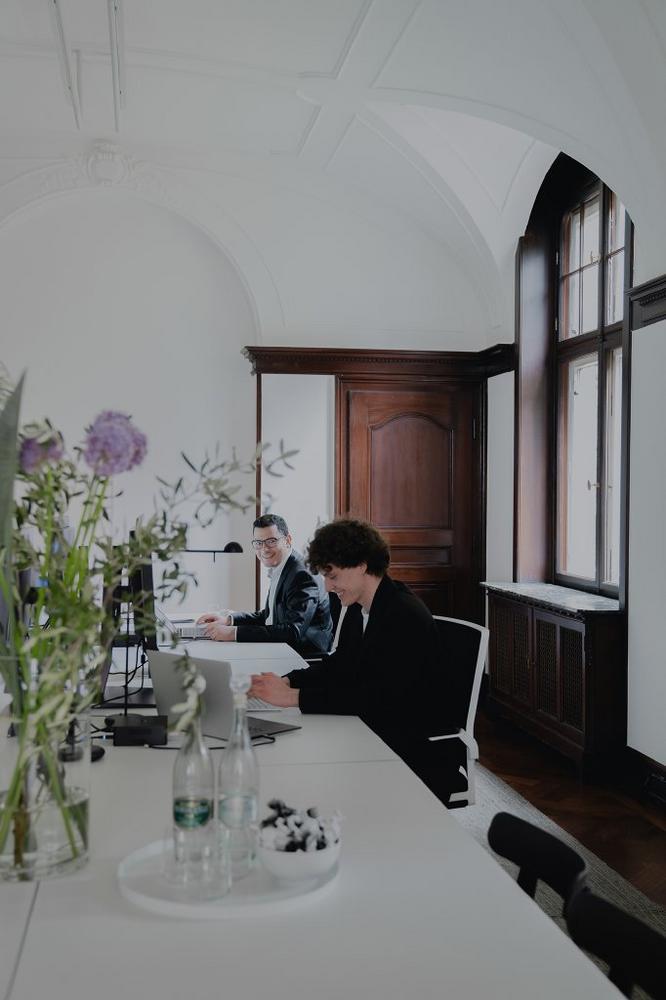
Most of these workplaces are top-class, fitted out with furniture from the two or three leading manufacturers in the industry. You see quality, you see investment. But you rarely feel anything. What’s missing is what we take for granted in private interiors: a personal signature, a story, a soul.
High-end, expensive – and strikingly similar
No one can accuse the decision-makers of lacking dedication. Budgets were spent, showrooms visited, brochures studied. The chairs are ergonomic, the desks height-adjustable, the sofas plush enough for the next employer-branding photo. And yet, the result often feels like a perfectly curated but faceless sample room.
Coworking corners look like twins, meeting rooms differ only in name, and the tea kitchens follow nearly identical blueprints: a touch of raw steel, dark wood, open shelving – industrial chic as obligatory décor. Those who move from one office to another often change only the postal code, not the spatial experience.
Spaces without a story
The real problem is subtler than “beautiful” or “not.” It’s the absence of narrative. Spaces that say nothing about the company working within them remain interchangeable, no matter how well planned. They express no attitude, no culture, no vision. They could belong to one corporation today and another tomorrow – without anyone noticing.
This is how workplaces are created that are functional yet emotionally empty. Professional, yes – but missing the spark that makes people truly connect to a place. You can sense the money that went into them. You just can’t sense what it was spent for.
A studio as counterpoint
At the Frankfurt studio of Philipp Architekten, the goal was to close exactly this gap. Instead of designing just another “proper” office, the idea was to make a spatial statement: What would a workplace look like if it were as bespoke as a tailor-made villa – only for everyday work?
The result is a sequence of spaces that break away from standard grids. Color schemes shift with function, light is staged rather than merely installed, and materials are deliberately combined instead of catalog-standardized. There are corners that surprise, sightlines that spark curiosity, and zones that feel as if they were conceived for exactly this team, this work, this mindset.
Nothing about it is loud or showy – but everything is intentional. And that makes all the difference: the space could belong to no other office. It tells you who works here – and why.
The soul of the workplace
The question isn’t whether an office tower needs an impressive lobby. The question is whether the floors behind it – the ones where people spend eight or nine hours a day – deserve the same attention. Whether a company is willing to invest not only in furniture but in identity.
Because in the end, it’s the same in architecture as everywhere else: you can design spaces correctly – or you can give them a soul. Most offices in financial centers are the former. It’s time to ask for more of the latter.
Call to action
With their Frankfurt studio, Philipp Architekten demonstrate how “copy-paste” can evolve into genuine corporate identity – crafting spaces that express attitude, not just aesthetics. For companies seeking more than the next beautifully furnished standard floor plan, new possibilities emerge: workplaces that don’t just function but resonate – lasting in memory and emotion alike.
Philipp Architekten is a multi-award-winning architecture and interior design practice with studios in Waldenburg (Germany), Frankfurt am Main (Germany), and Zurich (Switzerland). Led by Anna Philipp — the eleventh generation of a long family building dynasty — the firm specializes in exclusive residential architecture, heritage restoration, and bespoke interior design. Philipp Architekten is the originator of the Collectible Architecture concept — a pioneering philosophy that treats buildings as unique, collectible works of art defined by the highest standards of craftsmanship, artistic vision, and material excellence.
"Beauty matters."
Philipp Architekten GmbH
Schlossstrasse 16
74638 Waldenburg
Telefon: +49 791 75990
http://www.philipparchitekten.de
Referentin für Marketing und Öffentlichkeitsarbeit
Telefon: 0791759925
E-Mail: nk@philipparchitekten.de
