
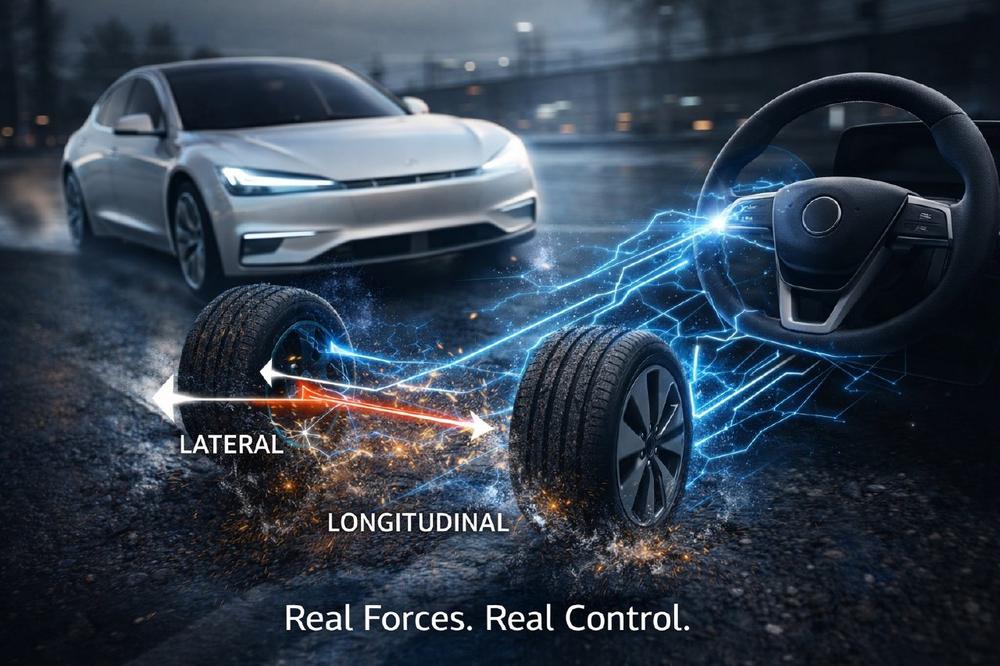
For autonomous and teleoperated systems, this perspective falls short. As soon as vehicle control becomes fully digital, the role of feedback changes fundamentally. It is no longer an expression of a driving sensation, but rather part of the system’s function.
Feedback is information
Force feedback is often viewed from a human perspective. In reality, however, it is primarily a form of physical feedback.
It arises from the forces between the tires, the road surface, and the vehicle and reflects conditions that cannot be fully derived from external sensors. These include, among others:
- Limits of traction
- Changes in coefficient of friction
- Slip conditions
- Transitions from stable to unstable vehicle dynamics
These effects often occur earlier and are more subtle than they can be reliably detected by camera-based systems or conventional environmental sensors.
What the AD stack lacks without physical feedback
Autonomous driving systems are based on models that make assumptions about vehicle behavior, friction coefficients, and environmental conditions. In reality, however, these assumptions are always subject to uncertainty. Without physical feedback, the system is often limited to indirectly observing the effects of its own commands. Only when the vehicle begins to deviate from its planned trajectory does it become apparent that the underlying assumptions are no longer valid.
Especially under changing road conditions—such as wet, icy, or loose surfaces—this can lead to maneuvers being requested that are no longer physically safe to execute. Physically accurate force feedback closes this gap by immediately revealing how much physical reserve is actually available.
Force Feedback as Part of the Control System
When force feedback is considered systemically, it is not a downstream effect but part of the control loop. The feedback of real forces makes it possible to detect critical conditions early on and incorporate them into the decision-making logic.
Autonomous systems thus do not react only when deviations become visible, but can anticipate developments before they become critical. Force feedback thus becomes an additional sensory channel for the AD stack—physical rather than visual or acoustic.
Impact on Driving Strategy
The integration of physical feedback has a direct impact on the driving strategy of autonomous systems. Speed, steering angle, and acceleration cannot be derived solely from the environment and geometry but must be continuously calibrated against actual driving dynamics.
Without this feedback, autonomy inevitably remains either conservative or risky: either large safety margins are built in, or situations arise in which physical limits are unexpectedly exceeded. Physically accurate force feedback, on the other hand, enables an adaptive driving strategy that is based on actual physical conditions.
Human and System in the Same Control Loop
In teleoperated or supervised scenarios, the human becomes part of the system again. Force feedback serves a dual function here: it conveys physical states to the operator while simultaneously enabling a consistent handover between autonomous control and human control.
The key factor here is that both access the same physical reality. Feedback is not interpreted or simulated, but is based on real forces. This increases predictability and reduces discontinuities in system behavior.
Why Physically Accurate Force Feedback Is Rare
Implementing physically accurate feedback is technically challenging. It requires tight coupling of actuators and sensors, deterministic control, a consistent system architecture, and functional safety even in the event of a fault.
Standards such as ISO 26262 for functional safety define fundamental requirements for safety-critical systems but do not automatically address the quality of physical feedback in the control loop. In many architectures, force feedback is therefore still treated as a comfort feature rather than an integral part of vehicle control.
A Maturity Indicator for Drive-by-Wire Systems
Whether a drive-by-wire system provides physically accurate feedback is a reliable indicator of its maturity. It shows whether vehicle control is understood as an isolated function or as a closed-loop system between digital decision-making and physical reality.
Platforms such as NX NextMotion from Arnold NextG pursue such a systemic approach by implementing vehicle control as an integrated control loop and incorporating physical feedback as part of the overall architecture.
Feedback as the Foundation of Control
Autonomous systems must not only make decisions but also understand their own limits. Physically accurate force feedback makes these limits visible and usable—for both humans and machines alike.
It connects digital decision-making logic with real-world physics and turns vehicle control into an adaptive process. Force feedback is therefore not a comfort feature. It is a physical sensor for system limits.
Outlook
In the next post in this series, we’ll examine where true drive-by-wire maturity comes from—and why it rarely emerges from pure autonomy projects, but rather from applications where physical feedback and electronic vehicle control have been used under real-world conditions for years.
We control what moves!
more information: www.arnoldnextg.com/blog
Arnold NextG realisiert die Safety-by-Wire®-Technologie von morgen: das mehrfach redundante Zentralsteuergerät NX NextMotion ermöglicht eine ausfallsichere und individuelle Implementierung, fahrzeugplattform-unabhängig und weltweit einzigartig. Mit dem System können autonome Fahrzeugkonzepte sicher und nach den neuesten Hard- und Software- sowie Sicherheitsstandards umgesetzt werden, ebenso wie Remote-, Teleoperation- oder Platooning- Lösungen Als unabhängiger Vorausentwickler, Inkubator und Systemlieferant übernimmt Arnold NextG die Planung und Umsetzung – von der Vision bis zur Straßenzulassung. Mit der Straßenzulassung von NX NextMotion setzen wir den globalen Drive-by-Wire-Standard. www.arnoldnextg.de
About Arnold NextG:
Arnold NextG realizes the safety-by-wire® technology of tomorrow: The multi-redundant central control unit NX NextMotion enables a fail-safe and individual implementation, independent of the vehicle platform and unique worldwide. The system can be used to safely implement autonomous vehicle concepts in accordance with the latest hardware, software and safety standards, as well as remote control, teleoperation or platooning solutions. As an independent pre-developer, incubator and system supplier, Arnold NextG takes care of planning and implementation – from vision to road approval. With the road approval of NX NextMotion, we are setting the global drive-by-wire standard. www.arnoldnextg.com
Arnold NextG GmbH
Breite 3
72539 Pfronstetten-Aichelau
Telefon: +49 171 5340377
http://www.arnoldnextg.de
Business and Corporate Development
E-Mail: mathias.koch@arnoldnextg.de
