
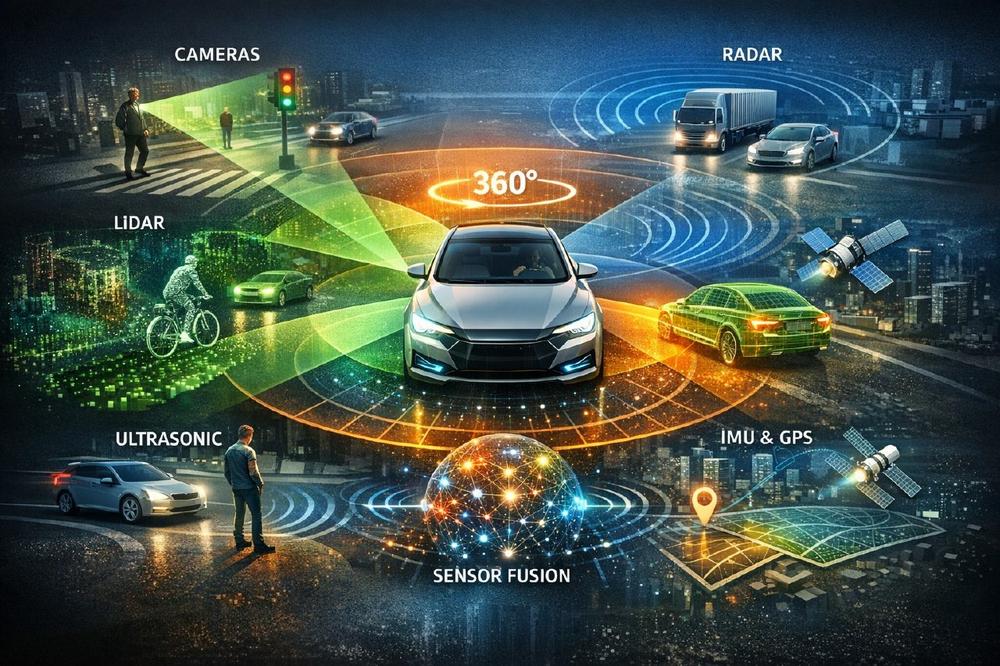
But "seeing" alone is not enough. For autonomous systems, it is not the detection of objects that counts, but the understanding of situations – robustly, redundantly, and without any loss of time. This is exactly where sensor fusion comes in: it combines different sensor data into a consistent, resilient model of the world – as the basis for every automated decision.
This article highlights the technical fundamentals of modern vehicle sensor technology, shows specific areas of application, and explains why perception will only become the safety architecture of the future through drive-by-wire.
The "senses" of autonomous vehicles: essential sensor types explained
The basis of every automated decision is a complete, reliable picture of the environment. To achieve this, autonomous vehicles rely on an entire sensor ecosystem. Each sensor type has specific tasks and technical strengths – but also limitations:
- Cameras capture visual features such as colors, signs, and lane markings – but are vulnerable in darkness or glare.
- Radar measures distances and speeds precisely – regardless of weather conditions, but with lower resolution.
- LiDAR generates highly detailed 3D point clouds – sensitive, but ideal for depth perception.
- Ultrasonic sensors offer robust close-range detection – for example, when parking or maneuvering.
- IMUs and GPS provide information about position, acceleration, and orientation—indispensable for self-localization and stabilization.
"There is no single miracle sensor. True perception comes from redundancy and fusion." Dr. Alex Grbic, CTO, AEye Lidar Systems
Sensor fusion: The art of consistent world perception
For autonomous systems to function reliably, they must not only "see" but also understand. This is where sensor fusion comes in. It combines different sensor data into a robust, multidimensional world model – compensating for the strengths and weaknesses of individual sensors.
Sensor fusion typically operates on three hierarchical levels:
- Low-level fusion: Merging raw sensor data
- Mid-level fusion: Combining recognized object features
- High-level fusion: Interpretation and decision-making based on consolidated data
The goal: a redundant, consistent basis for automated decisions. This basis is essential as soon as vehicles move autonomously or semi-autonomously – for example, at SAE Level 3 and above.
"Sensor fusion is critical for redundancy and trust – especially from SAE Level 3 onwards." White paper by Mobileye & Intel, 2024
Fields of application: From urban complexity to industrial precision
The practical relevance of sensor fusion is evident in a wide variety of industries:
- Public transportation: Autonomous shuttles combine camera and LiDAR data to safely detect traffic lights, passengers, and traffic density – even in urban environments.
- Logistics & port operations: Radar-based obstacle avoidance with LiDAR fine-tuning enables collision-free docking – supported by GPS and IMUs.
- Mining & construction sites: Radar, thermal imaging technology, and robust control logic are used in extreme environments – combined with redundant remote control.
- Defense: Military vehicles use multi-layer sensor arrays with separate computing technology – for a fail-operational architecture even in the event of failures.
Perception is not enough – real-time action is the key
The best sensor technology is useless if the decision comes too late. The seamless connection between perception and control – with minimal latency – is crucial. As soon as an object has been classified by sensor fusion, the vehicle must react immediately: brake, swerve, stop.
This is exactly what NX NextMotion – the central motion platform from Arnold NextG – was developed for. It combines:
- 4-fold redundant sensor and control paths
- Real-time perception and edge computing
- Certified drive, steer, and brake-by-wire technology
This combination enables a continuous, fault-tolerant chain from object detection to vehicle action – including cybersecurity in accordance with ISO 21434 and safety architecture in accordance with ASIL D and SIL3.
AI & Edge: The next step in vehicle perception
With growing system intelligence, data processing is increasingly shifting to the vehicle itself. Edge AI replaces central cloud logic – reactions occur locally, in milliseconds. This reduces dependencies, increases reliability, and opens up new possibilities for self-learning systems.
At the same time, the requirements are increasing:
- Thermal management and real-time processing
- Cybersecurity in distributed systems
- Reliability under extreme conditions
The NX NextMotion platform from Arnold NextG is equipped to meet these requirements – thanks to its modular architecture, integrated diagnostic systems, and platform-independent compatibility.
Conclusion: Perception is more than just sensor technology – it is real-time trust.
Autonomous driving begins with recognition – but it ends with understanding and acting. True safety comes from redundancy, fusion, and a robust, real-time control architecture. Arnold NextG sets new standards for reliable, scalable vehicle intelligence with NX NextMotion—regardless of vehicle type or application.
The future belongs to systems that make decisions in milliseconds – and guarantee safety at all times.
We control what moves!
Arnold NextG realizes the safety-by-wire® technology of tomorrow: The multi-redundant central control unit NX NextMotion enables a fail-safe and individual implementation, independent of the vehicle platform and unique worldwide. The system can be used to safely implement autonomous vehicle concepts in accordance with the latest hardware, software and safety standards, as well as remote control, teleoperation or platooning solutions. As an independent pre-developer, incubator and system supplier, Arnold NextG takes care of planning and implementation – from vision to road approval. With the road approval of NX NextMotion, we are setting the global drive-by-wire standard. www.arnoldnextg.com
Arnold NextG GmbH
Breite 3
72539 Pfronstetten-Aichelau
Telefon: +49 171 5340377
http://www.arnoldnextg.de
Business and Corporate Development
E-Mail: mathias.koch@arnoldnextg.de
