
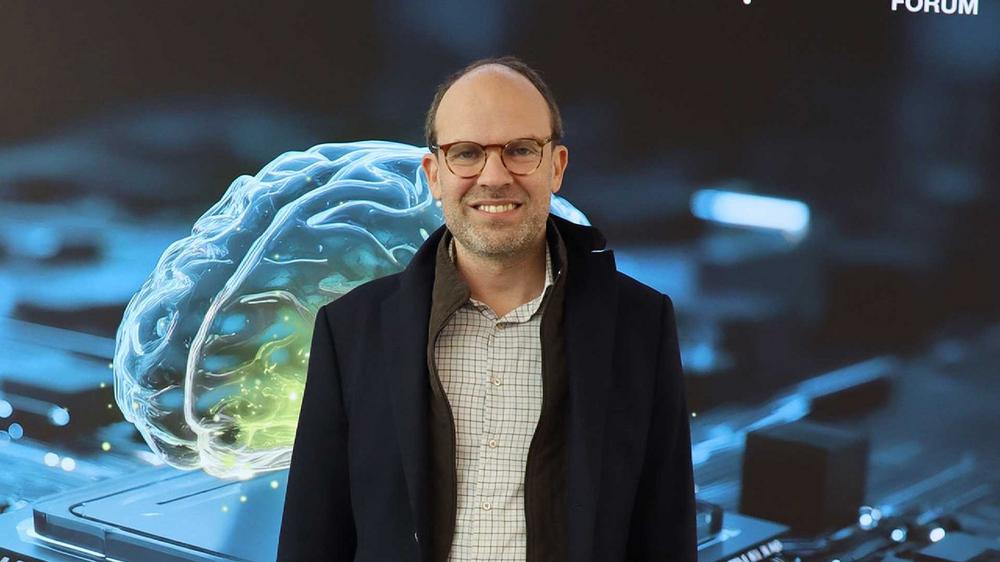
Frey is convinced that technology and innovation are primarily driving continuous growth in human prosperity, but that technological change can also be a disruptive force. “Progress is not a natural thing, otherwise it would not have taken humanity 200,000 years to experience the first industrial revolution,” says the scientist. In what is now the fourth industrial revolution, driven by AI, Frey sees a need for action: “The models economists use to describe the collaboration between humans and computers at work incomplete at best.” This is exactly where the professor comes in.
Computer science meets economics
As an economist, Frey works with an expert from another discipline on technological issues: “I was fortunate enough to meet a colleague from the computer science department with whom I am jointly exploring the topic of automation.” Publications related to AI are currently receiving the most public attention. However, Frey himself has another favorite among his works: “My new book, entitled ‘How Progress Ends’, is the most important work I have ever written.” The book was shortlisted for the Financial Times & Schroders Business Book of the Year 2025. In it, Frey looks back over the past thousand years and shows why some societies benefit from rapid technological change and others fail as a result.
Interdisciplinarity and internationality are major advantages of Oxford’s location. It is not only economists and computer scientists who work together here: “There are few other places where a classicist can sit next to a physicist in the common room or at dinner.” So, it was only logical for Frey to move to the time-honored university location after studying in Sweden and completing his doctorate in Munich. Frey says of Oxford: “What makes it special is the combination of its history and the fact that we have some of the most forward-looking institutions in the world, such as the Oxford Internet Institute and the Oxford Marketing School.”
Learning from each other
The TUM Campus Heilbronn Joint Global AI Research Hub successfully bridges this gap even beyond national borders. “In this forum, I get to know colleagues from partner universities who are conducting research in the same field but specialize in different areas. Over time, this leads to new ideas, inspiration and, hopefully, new collaborations,” says Frey. After all, the expert in “AI & Work” certainly has no shortage of projects: “The impact of AI on language skills and resilience, or the influence of technology on companies that use AI in good times and bad, are topics we are looking into.” In future also across universities and countries.
Die TUM Campus Heilbronn gGmbH
Bildungscampus 2
74076 Heilbronn
Telefon: +49 (0) 7131 264180
Telefax: +49 (7131) 645636-27
https://www.chn.tum.de/de
Telefon: +49 (7131) 26418-501
E-Mail: Kerstin.Besemer@tumheilbronn-ggmbh.de
