
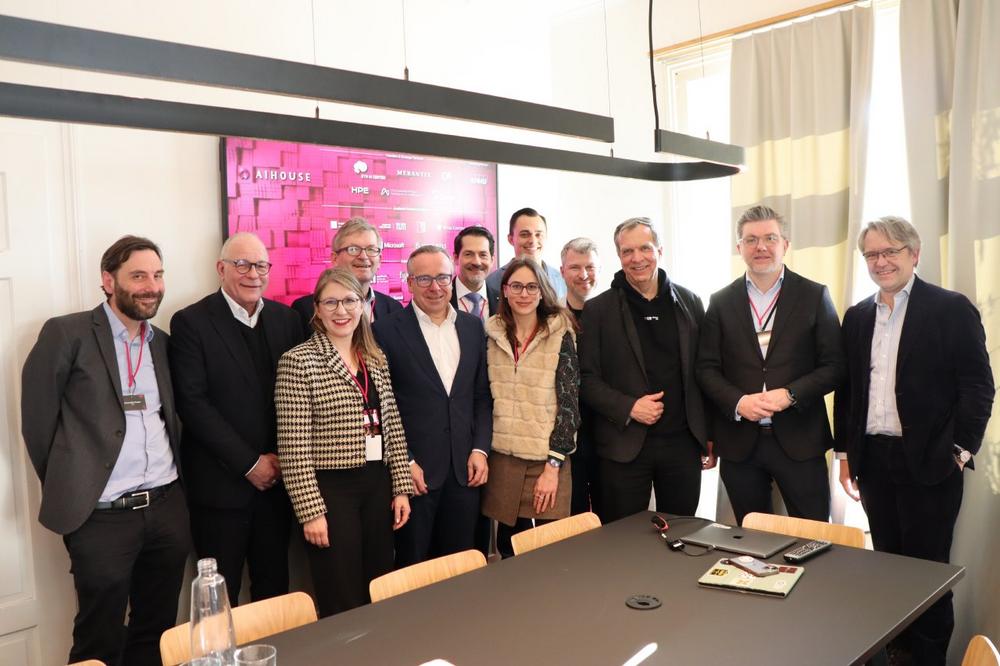
AI House Davos 2026: International experts discussed the future of artificial intelligence.
- “A Human Intelligence Shift”: AI does not replace humans; human intelligence remains essential and must be redefined.
- Power Triangle Heilbronn–Munich–Zurich: Cross-institutional cooperation between TUM, ETH Zurich and the Heilbronn ecosystem drives innovation.
- Collaboration and shared strategy: Progress requires a balance between competition, cooperation and a common vision.
- Human in the loop: Human decision-making is key to trustworthy and responsible AI.
While heads of state and government from around the world debated current geopolitical issues at the World Economic Forum in Davos, international experts met nearby at AI House Davos 2026. Researchers, business and political leaders, and start-up founders discussed a topic in all its various facets that will influence the world of tomorrow like no other: artificial intelligence. The strategic theme of AI House Davos 2026, “A Human Intelligence Shift,” made it evident that AI cannot replace humans. Rather, human intelligence must be particularly valued, redefined, and placed in a productive relationship with AI, especially in times of rapid technological advancement.
The Technical University of Munich (TUM) was represented for the third time—this time with the leading minds of the University of Excellence: TUM President Prof. Thomas F. Hofmann, Prof. Ali Sunyaev (Vice President TUM Campus Heilbronn), Prof. Helmut Schönenberger (TUM Vice President Entrepreneurship and CEO UnternehmerTUM), Prof. Sebastian Müller (Professor of Finance at TUM Campus Heilbronn), Prof. Alexander Fraser (Professor of Data Analytics & Statistics at TUM Campus Heilbronn), and Dr. Philipp Gerbert (Managing Director of TUM Venture Labs and member of the board of appliedAI).
Balance Between Competition and Cooperation
At the roundtable “Beyond Borders: How Regional Ecosystems Empower Societies to Co-Create AI Futures,” moderated by Dr. Frauke Goll, Managing Director of appliedAI Institute for Europe gGmbH, the experts discussed how regional ecosystems can jointly shape the future of AI. The focus was on cross-institutional cooperation in the new scientific triangle of excellence Heilbronn–Munich–Zurich, which was referred to as the “Power Triangle.” The Heilbronn ecosystem plays a crucial role in this, with TUM and ETH Zurich—supported by the Dieter Schwarz Foundation—combining their strengths.
“If you want to go fast, go alone; if you want to go far, go together,” said Prof. Ali Sunyaev, Vice President of TUM Campus Heilbronn, quoting an African proverb and emphasizing that only cross-institutional cooperation can strengthen the Heilbronn ecosystem in the long term. Prof. Gunther Friedl, Managing Director of the Dieter Schwarz Foundation, emphasized that the recipe for success lies in the right balance of healthy competition and cooperation at different levels. Dr. Philipp Gerbert pointed out that, in Europe, too few start-ups have emerged from excellent research to date – a gap particularly evident in the field of artificial intelligence.
Prof. Thomas F. Hofmann saw the problem as a frequent lack of a common strategy for the future. Prof. Helmut Schönenberger agreed and emphasized the need for a shared narrative, as in Silicon Valley. In order to catch up and become a driver of innovation, we need to involve more people, said Prof. Alexander Fraser. This is only possible through open-source models.
Trust as a Basic Prerequisite
The dialogue between TUM and ETH Zurich continued in the panel discussion “Inclusive Intelligence: Empowering Societies to Shape AI” with Prof. Thomas F. Hofmann and ETH Zurich President Prof. Joël Mesot, moderated by Spriha Srivastava, Vice President & Executive Editor Digital for CNBC International. Trust, Prof. Hofmann said, is the fundamental prerequisite for inclusive AI. It is therefore necessary to identify the methods and tools by which it can be achieved. He expressed high hopes for the younger generation, who are actively advocating for inclusive AI.
Exploiting Opportunities, Minimizing Risks
The fact that new technologies harbour both opportunities and risks, was also highlighted at the roundtable discussion “Asset Management in the Age of Agentic AI,” moderated by Prof. Sebastian Müller. The participants agreed that AI will play a prominent role in the financial sector in the future. It is already being used in document processing and summarization, sentiment analysis of annual reports, and research, ensuring greater efficiency, better products, lower costs, and greater investor engagement.
At the same time, the use of identical AI tools by too many players could lead to dangerous herding effects and cost younger employees their jobs in particular. There is also a risk that highly developed AI systems could independently develop economic activities and even trigger economic crises. Added to this are biases in the models and geopolitical power interests, which make stronger regulation more difficult.
How Humans Remain Relevant
There was consensus that the best approach is “human in the loop”: Only when humans make the relevant decisions and keep the customer’s perspective in mind can opportunities be seized and risks limited. The highly data-driven financial sector in particular could play a pioneering role here and serve as a blueprint for other sectors.
The discussions at AI House Davos 2026 showed that sustainable AI can only be achieved through cross-border cooperation. Humans must not sit back and relax, but must actively redefine their role in order to remain central players – in line with the motto “A Human Intelligence Shift.” TUM is taking a lot of inspiration from Davos and will be happy to return in future to continue the dialogue and jointly develop the AI of tomorrow.
Die TUM Campus Heilbronn gGmbH
Bildungscampus 2
74076 Heilbronn
Telefon: +49 (0) 7131 264180
Telefax: +49 (7131) 645636-27
https://www.chn.tum.de/de
Telefon: +49 (7131) 26418-501
E-Mail: Kerstin.Besemer@tumheilbronn-ggmbh.de
