
Quality in automation and product
One might assume that very high quality in laboratory products such as Petri dishes has become standard nowadays. However, there are still significant differences in quality, which are caused not only by the material but also by the production and handling of the dishes. High-quality Petri dishes that also meet the strict hygiene requirements in laboratories and other medical facilities can only be achieved through fully automated handling during production. Human intervention is reduced to a minimum, thus preventing possible contamination of the dishes.
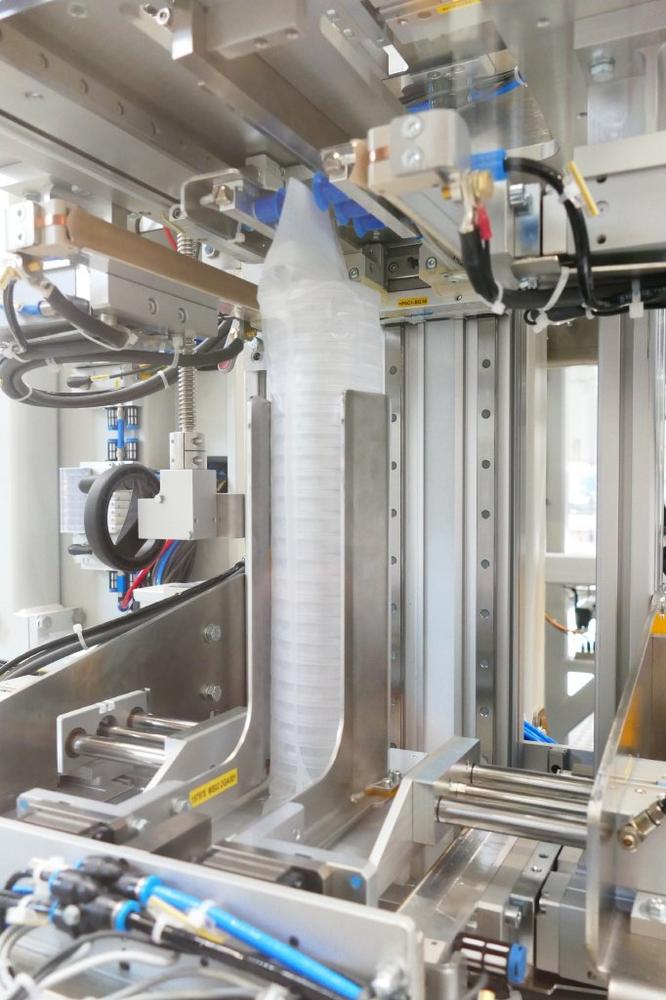
Another factor that contributes to quality is the robustness and design of the automation system. This is achieved through the use of high-quality materials in all components of the system, resulting in an extremely reliable system with optimum technical availability. In addition, the dishes are handled in a very product-friendly manner with contact-sensitive grippers and conveyor elements to prevent scratches or microscopic damage.
The risk of damaged products, which would drive up the reject rate, is also eliminated by vacuum-sealing the tube bags in which the Petri dishes are packaged. This step in the process, which is often omitted in the production of Petri dishes in favor of shorter cycle times and thus higher output and lower investment costs, is nevertheless crucial for product quality. Although there are no visible differences in quality during the manufacturing process itself, significant defects in the form of scratches can occur during transport of the packaged laboratory products due to the dishes rubbing against each other. Entire batches of defective goods often arrive at the laboratory as a result. This can be prevented by vacuum sealing the tube bags, as the trays no longer have any scope for movement within the compressed packaging. This means that the initially higher investment costs for this process step would amortize very quickly and ultimately result in significantly better product quality. Since production philosophies and conditions differ significantly from manufacturer to manufacturer, BBS has decided to offer this process as an option in the HEKUdish next Gen solution. However, even with the integration of vacuuming, the system can more than keep pace in terms of speed with the world’s leading automation providers for Petri dishes, which achieve comparable cycle times without vacuuming.
More speed, more output
The speed of the automation systems has always been a flagship feature of BBS in Hallbergmoos, ultimately giving customers a clear competitive advantage in terms of output. However, the company did not want to rest on its achievements and has managed to raise the bar even higher.
The Achilles heel in terms of cycle time for Petri dish automation was the packaging unit, which means feeding the foil tube, inserting the stack of dishes into the tube, vacuuming, sealing, and cutting the tube bag. This is precisely where BBS started its development work, taking another detailed look at the process steps and finding a solution with an intelligent, new process design that greatly optimized the bottleneck in terms of cycle time. Depending on the type of material, the wall thickness of the dishes, the stack height, the selected options for foil tube feeding and vacuuming, cycle times of only 3.6 to 4.3 seconds can be achieved. In comparison, the first generation of HEKUdish systems could only achieve cycle times of 4 to 6 seconds. An optimization of 0.4 seconds may not sound much at first, but when looking at an automation system with 8 cavities, this means an additional output of over 5 million parts per year. Overall, with a production capacity of up to 55 million Petri dishes per year, the HEKUdish next Gen can be described as a real powerhouse.
In addition, the revised concept addresses another issue that benefits annual output: planned downtime. In the second generation of the HEKUdish, careful attention was paid to a design that is also very user-friendly in operation and maintenance. Exchange kits are easy for the operator to replace, which significantly reduces the effort associated with product changes and increases production times. The stacking height can also be adjusted quickly, saving time here as well. This responds to the market trend that manufacturers are facing, which is to quickly adapt their production volumes and variants to changing requirements.
Flexibility as the key
Rapid adaptability to changing production requirements was an essential key development goal for the second generation of HEKUdish.
In terms of cavity numbers, the 2+2 solution for smaller production volumes and the 8+8 variant for large-scale production offer similar flexibility to the first generation. The processable dish diameter of 30 to 110 mm also covers almost all common Petri dish sizes and can be flexibly displayed on one system through the use of interchangeable sets.
The aforementioned variability in stacking up to a height of 500 millimeters with 10 to 32 dishes also gives producers the option of responding to different production batches as required. With the option of vacuuming, different feed options for the foil tube, and the possible integration of secondary packaging, such as cardboard packaging, manufacturers can configure their preferred packaging system to suit their production needs.
All these advantages, which other automation systems often do not offer, have already been provided in a similar form in the first generation of HEKUdish. However, the real game changer in terms of flexibility for BBS and thus also for its customers lies in the next generation’s ability to convert the system to a different product type. This means that both Petri dishes and contact dishes can be produced on the same system. The difference between the two products is that the lid of a Petri dish covers the base, whereas the base of a contact dish is larger than the lid. This difference means that after being taken out of the injection mold, the two halves of the dish require completely different handling procedures for assembly in the transfer station. Until now, this meant that customers needed two different automation systems with separate concepts for both product types. With the HEKUdish next Gen, this now belongs to the past. Its intelligent process design allows both products to be manufactured on a single system with a simple changeover. This enables customers to save not only investment costs but also valuable production space.
All in all, it can be stated that BBS Automation is setting new standards in the automated handling of Petri dishes with the second generation of the HEKUdish platform. “With the next generation, we are continuing our success story. We listened carefully to our customers and wanted to develop a system that is both fast and flexible – without compromising on quality,” sums up Markus Porath, product manager for Petri dishes at BBS. For manufacturers, this means a system at a competitive price that offers more output, less downtime, excellent product quality, and better adaptability to a wide range of product variants—a strategic production factor that leads to a clear competitive advantage!
BBS delivers scalable, smart, and tailored automation solutions from a single source, serving the mobility, medtech, consumer goods, new energy, and electronics industries. With 2,500 employees and sites in Europe, North America, and Asia, BBS is a leading industrial automation provider and part of the Dürr Group.
The BBS site in Hallbergmoos, with approximately 200 employees, specializes in insertion and take-out technology in and from injection molding machines and the associated requirements for complex production processes with the highest quality and overall system availability.
BBS Automation Hallbergmoos GmbH
Dornierstr. 14
85399 Hallbergmoos
Telefon: +49 (811) 999 77 0
http://www.bbsautomation.com
Senior Marketing Manager
Telefon: +49 (811) 999 77 0
E-Mail: marketing@bbsautomation.com
