
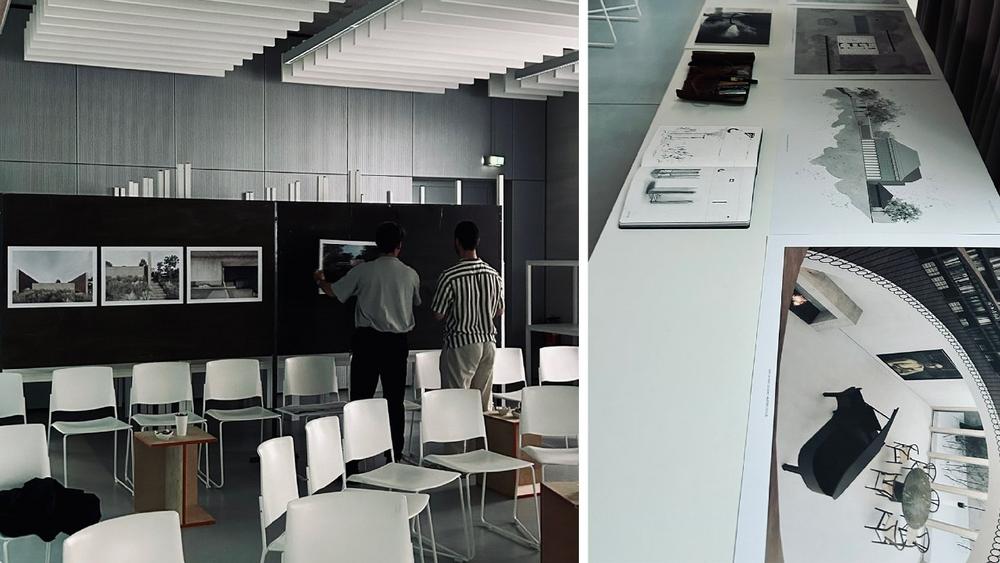
It was precisely these questions that Anna Philipp, owner and Creative Director of Philipp Architekten, used to open her lecture at Stuttgart Technical University of Applied Sciences (HFT). Invited by Prof. Harald Roser as part of the “Design Theory 2” module, she spoke to architecture students and delivered a lecture that went far beyond a classic portfolio presentation.
A film as a door opener
The event did not begin with the projection of floor plans or facade elevations, but with a film: "An Oasis in the City". The choice was deliberate. Before numbers, data and construction principles dominate the conversation, the audience was first invited to experience space — through images, moods, light and movement.
The project portrayed in the film initially receded into the background. Taking center stage instead was the core concern of the entire lecture: the question of perception.
Architecture, in Philipp’s view, does not begin at the drawing board. It begins in the moment when a person enters a space, pauses and feels: This is where I belong. Or not. This experience — intuitive, physical, emotional — is the true benchmark of good design.
Design as an open process
What followed was not a polished success story. Anna Philipp opened up the design process in all its complexity — with its searches, missteps and turning points.
Using five carefully selected projects from her practice, she showed how architectural ideas come into being: not linearly, not strictly according to plan, but in an ongoing dialogue between concept and material, between intuition and analysis.
Sketches, study models and material explorations were not presented as mere preliminary stages to the “real” project, but as independent instruments of insight. They reveal how architecture thinks — how ideas take shape, are discarded, condensed and ultimately lead to a spatial solution that is more than the sum of its parts.
Particular attention was paid to three themes that have shaped the design process at Philipp Architekten from the outset: materiality, the orchestration of light and spatial sequences. Not as a checklist, but as a language — the means through which architecture communicates with its inhabitants.
Beauty as an attitude
The unifying motif of the entire lecture was a term that is often avoided in contemporary architectural discourse for being too romantic or not tangible enough: beauty. Anna Philipp addressed this head-on.
Beauty, she argued, is not an ingredient added to a project at the very end. It is the result of a consistent design attitude — a form of attention that accompanies every step of the process.
It emerges where proportion and structure, choice of materials and detailing, atmosphere and usability come into a balance that feels effortless: natural rather than strained, precise rather than cold.
It is this attitude that has characterised Philipp Architekten for years: a design ambition that does not settle for what merely functions, but understands the sensual and the handcrafted as equally valid architectural categories.
Practice and reflection as one
With her lecture at Stuttgart Technical University of Applied Sciences, Anna Philipp underlined a self-image that refuses to separate designing and thinking.
Those who build assume responsibility — for space, for the people who inhabit it, and for the built environment as a cultural legacy. This responsibility demands not only craftsmanship and technical excellence, but also a willingness for continuous reflection: on one’s own practice, on the impact of space and on the questions architecture poses to our society.
The subsequent discussion with students and faculty made clear how strong the need is for precisely this kind of discourse. The questions raised — about beauty and aesthetics, about the role of intuition in design, about architecture in the tension between economics and culture — were lively, sometimes controversial and driven by a genuine desire for insight.
Philipp Architekten would like to thank Prof. Harald Roser and Stuttgart Technical University of Applied Sciences for the invitation and for the open, inspiring and inspiringly thoughtful exchange.
About Anna Philipp and Philipp Architekten:
Anna Philipp is the founder and Creative Director of Philipp Architekten, with offices in Waldenburg, Frankfurt and Zurich. The practice stands for precise, sensorially experiential architecture. With a clear design philosophy, Philipp Architekten combines craftsmanship of the highest order with a profound understanding of space, materiality and atmosphere.
Philipp Architekten GmbH
Schlossstrasse 16
74638 Waldenburg
Telefon: +49 791 75990
http://www.philipparchitekten.de
Referentin für Marketing und Öffentlichkeitsarbeit
Telefon: +49 (791) 759925
E-Mail: nk@philipparchitekten.de
