
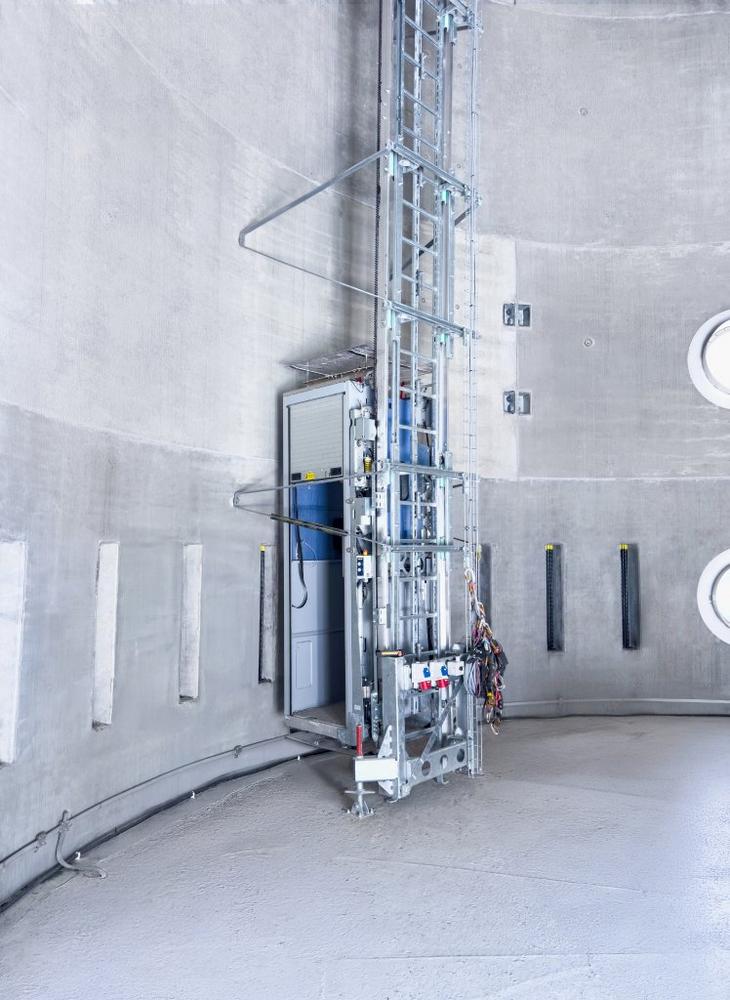
Use from the installation phase onwards
Whilst conventional rope lifts can only be used once the tower has been fully erected, the new lift can be used from the very first metre. This is made possible by ladder sections with a rack-and-pinion system, whose guide profiles start at ground level and grow as the tower is erected. As a result, in many cases the time-consuming and physically demanding task of climbing is no longer necessary during the installation phase.
Existing rope hoists, on the other hand, cannot be used until the tower is fully erected and the ropes for the hoist can be attached at the top. Furthermore, they can often only be used once the entire structure has been inspected and approved. The battery-powered rack-and-pinion lift, however, can be operated right from the start. This makes the work considerably easier, reduces risks and supports more efficient workflows on the construction site.
Easy transport, flexible installation and easy replacement
Once the cable route has been installed, the lift can be easily installed in the tower. A special transport frame allows for transport in both an upright and a horizontal position. Inside the tower, the machine can be erected in a horizontal position using a collapsible tubular frame.
Service and replacement were also taken into account from the outset: The machine can be moved onto the transport frame, detached from the guide system and removed in an ergonomically safe manner. This also makes it possible to remove it at a later date, even after more than 25 years, with minimal effort.
A response to the growing challenges facing modern wind turbines
As the height of modern wind turbines increases, the demands placed on transport systems rise significantly. Taller towers are economically attractive, as airflows at greater heights are more uniform and laminar. At the same time, however, tower deflections and mechanical stresses increase. At a tower height of around 200 metres, deflections of approximately ±2 metres can occur.
Conventional rope lifts are increasingly reaching their technical limits in this regard. Tower vibrations can cause ropes to strike internal structures, become damaged or become entangled. Replacement intervals and maintenance work also lead to downtime. Furthermore, the safety rope cannot be fully inspected before it reaches the upper part of the tower.
The battery-powered rack-and-pinion lift avoids these inherent drawbacks. Particularly when dealing with larger hub heights, this solution becomes increasingly attractive from both an economic and technical perspective in the long term.
Remote maintenance and image-based fault diagnosis improve availability
In addition to its mechanical design, the system incorporates state-of-the-art digital features. These include online remote maintenance, a touchscreen display in the lift car and image-based fault diagnosis. Operators and service teams can remotely check that the lift is in working order before it is used. Clear, visual information helps even less experienced users to operate the system and troubleshoot faults. In this way, the system helps to prevent unplanned downtime and reliably provides transport for up to two people and materials.
A modular overall concept rather than individual core innovations
The strength of the product lies not in any single component, but in the combination of numerous coordinated solutions. These include the resource-efficient guidance system, which does not require traditional cross-bracing, as rigidity is achieved via the connections to the external wall that are necessary in any case.
The landing has also been redesigned: an H-shaped layout allows passengers to step through the lift from below, right into the car and beyond. The anti-collision barrier can be opened ergonomically with a light kick when entering from above and swings automatically upwards out of the way.
Special components had to be developed for the central charge controller for bidirectional charging and discharging, as well as for the drive system, as no suitable solutions were available in this power class.
The battery-powered rack-and-pinion lift thus provides a solution that redefines safety, availability and operational efficiency in modern wind turbines – and brings about a lasting improvement in transport within the tower, from the installation phase right through to long-term maintenance operations.
GEDA GmbH
Mertinger Straße 60
86663 Asbach-Bäumenheim
Telefon: +49 (906) 9809-0
Telefax: +49 (906) 9809-50
http://www.geda.de
Marketing
Telefon: +49 (906) 9809-682
E-Mail: c.wilkenloh@geda.de
