
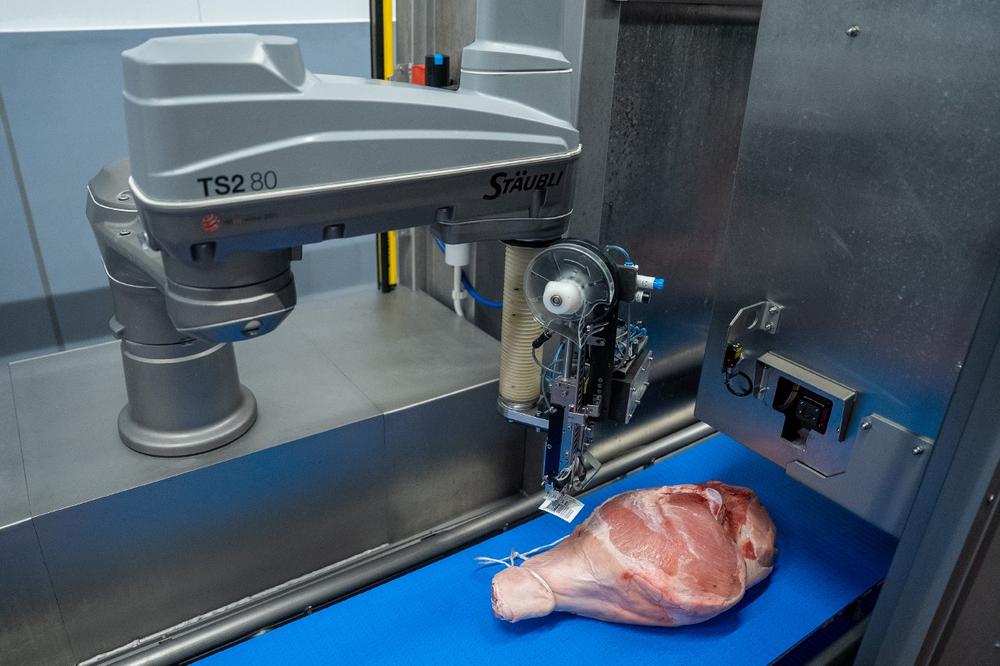
It takes 10 to 18 months of drying and ripening for a delicious Spanish Serrano ham to be ready for consumption, and this process consists of several steps. A medium-sized Serrano producer can process more than 5,000 hams per day, so labeling them with the week, year, and batch number is a small but crucial step early in the process. For human operators, this entails physical strain. It also requires expertise, as they must avoid areas with bones, which the application tool cannot penetrate.
No chance for automation?
It is obvious that given these conditions, automation would be progress. Yet, although the Serrano industry is not small, this goal has not been achieved, and it is equally obvious why: As a natural product, the position of the bones in the hams, which account for 30 to 40% of the total weight of an 8 to 12-kg Serrano ham, differs. For each individual ham, the operator must make individual choices based on their experience.
So, is there no chance of robot-based automation here, even though robots are certainly capable of applying labels? Timpolot, an automation expert located in Olot, a center of meat production in Eastern Spain, has found a solution by combining a Stäubli robot with a fastener applicator and an AI-supported vision system.
Robot-based labeling – with individual positioning
Jordi Bassols, founder and General Manager of Timpolot, describes the process: “The hams are manually placed on a conveyor belt in a random manner. A vision system identifies the position of each piece and, using AI, determines the ideal labeling point while avoiding bone impact.”
In the meantime, a printer creates a plastic label. A robot, installed beside the conveyor and equipped with a standard pneumatic fastener applicator, picks up the label and, guided by tracking coordinates from the camera, injects the applicator’s needle into the ham.
A robot that processes up to 180,000 kg of ham per day
The line described is operated by a major Serrano ham producer with a very high output. The SCARA robot, a Stäubli TS2-80 HE, processes 150,000 to 180,000 kg/day of ham at a continuous rate of 750 pieces/hour, peaking at 900 pieces/hour, which implies a cycle time of only four seconds. In fact, the robot could work even faster, but label printing and previous processes limit the speed.
Jordi Bassols: “By automating this task, we address several important aspects: first, improving job quality, reducing sick leaves, and allowing operators to be dedicated to higher-value tasks; and second, achieving better traceability control by centralizing all IT management at one single point.”
Designed for applications with high hygienic standards
The robot that Timpolot chose – the Stäubli TS2 series in the HE (humid environment) version – is designed for food industry applications. The surfaces are smooth, and the housing is designed to withstand regular cleaning with industrial detergents and medium-pressure water. Further, the robot is lubricated with food-grade H1 oil. “Hygiene is key in all food industry processes, and Stäubli ensures the reliability and food safety demanded by our clients,” Jordi Bassols adds.
But there are several other reasons why Timpolot opted for a Stäubli robot, such as the ease of programming it with the VAL3 system, and its mechanical excellence, with oil-immersed gear reducers that ensure a long lifetime. Smooth integration with the PLC is achieved through comprehensive connectivity to multiple industrial protocols. Stäubli also offers high-quality after- sales service worldwide.
In the words of Jordi Bassols, “Overall product quality is essential to a solid solution. With Stäubli, this quality is ensured, both in terms of finish and mechanical reliability. We know these robots will last for many years with few issues, which is key to guaranteeing that a production line is profitable in the long term.”
Data infrastructure: Connectivity between camera, AI-enabled PC, PLC, and robot
On the data and IT side, the camera is connected to a PC (running software developed by Timpolot), where image processing and AI-based analysis take place. The coordinates are sent to the PLC (Omron NX1P2), which transmits them to the robot via Ethernet/IP and manages the peripherals. In addition to handling I/O, the PLC serves as a key communication hub for all the line’s equipment, providing information to the operator via the HMI.
The role of AI is crucial here. Jordi Bassols: “Since hams are irregular objects, part of the algorithm uses traditional vision functions, but the integrated AI can determine the labeling point more precisely and predict bone positions, which prevents needle breakage during fastener injection.“
A food industry first: AI-based individual label application at top speed
The line has now been running for several months, to the client’s complete satisfaction. What makes it unique is the task it performs. Until now, labeling could only be performed by humans, as it is a complex process. As Jordi Bassols explains, “In the meat industry, no two pieces are identical, which makes handling more complex. The robot must allow smooth communication with the peripherals to adapt to constant changes. It also guarantees labeling quality, with all labels being placed in the same position on each ham, while ensuring reliable product traceability, enabling the client to deliver a high-quality final product.”
For Stäubli, the project was both a challenge and a success. Josep M. Serra, Robotics Director at Stäubli Española: “We have extensive experience with robots in the food industry, but this is not a common solution: a high-end automation system, adapted to high hygienic requirements, handling individual products with integrated AI and bespoke programming by Timpolot. We look forward to starting new projects with this innovative systems integrator."
Text: Industrie Kommunikation Högel
Timpolot: Automating the meat industry
Timpolot was founded in 2014 to develop robotic systems for the meat industry, backed by a focus on innovation and a strong commitment to the highest quality in every project. The meat industry is a key economic driver in the region of the company’s home base, Olot, about 100 km northeast of Barcelona, with several leading companies based there.
For more than 10 years, Timpolot has specialized in automating quality control processes and handling tasks in this industry. By integrating AI, the company’s engineers enable robots to perform tasks that were once unimaginable. Their development work focuses on key aspects such as hygienic design and food safety, resulting in systems that are easy to clean.
Stäubli is a global industrial and mechatronic solution provider with four dedicated Divisions: Electrical Connectors, Fluid Connectors, Robotics and Textile, serving customers who aim to increase their productivity in many industrial sectors. Stäubli currently operates in 28 countries, with agents in 50 countries on four continents. Its global workforce of 6,000 shares a commitment to partnering with customers in nearly every industry to provide comprehensive solutions with long-term support. Originally founded in 1892 as a small workshop in Horgen/Zurich, Switzerland, today Stäubli is an international Group headquartered in Pfäffikon, Switzerland.
https://www.staubli.com/global/en/home.html
About Stäubli Robotics
Stäubli Robotics is a leading global player in robotics, consistently delivering engineering as effective and reliable as our services. A complete solutions provider for digitally networked production, Stäubli offers a broad range of 4- and 6-axis robots including robotic arms designed specifically for sensitive environments, mobile robots, driver-less transport systems(AGVs) and cobots for human-robot collaboration.
[url=https://www.staubli.com/global/en/robotics/products.html]Robotic automation for industrial applications | Stäubli[/url]
https://www.linkedin.com/company/staubli-robotics/
Stäubli Tec-Systems GmbH Robotics
Theodor-Schmidt-Str. 19/25
95448 Bayreuth
Telefon: +49 (921) 883-0
Telefax: +49 (921) 883-3244
https://www.staubli.com/de/de/robotics.html
Manager of Marketing and Division Business-Marcom
Telefon: +49 (921) 883-3212
E-Mail: s.koban@staubli.com
