
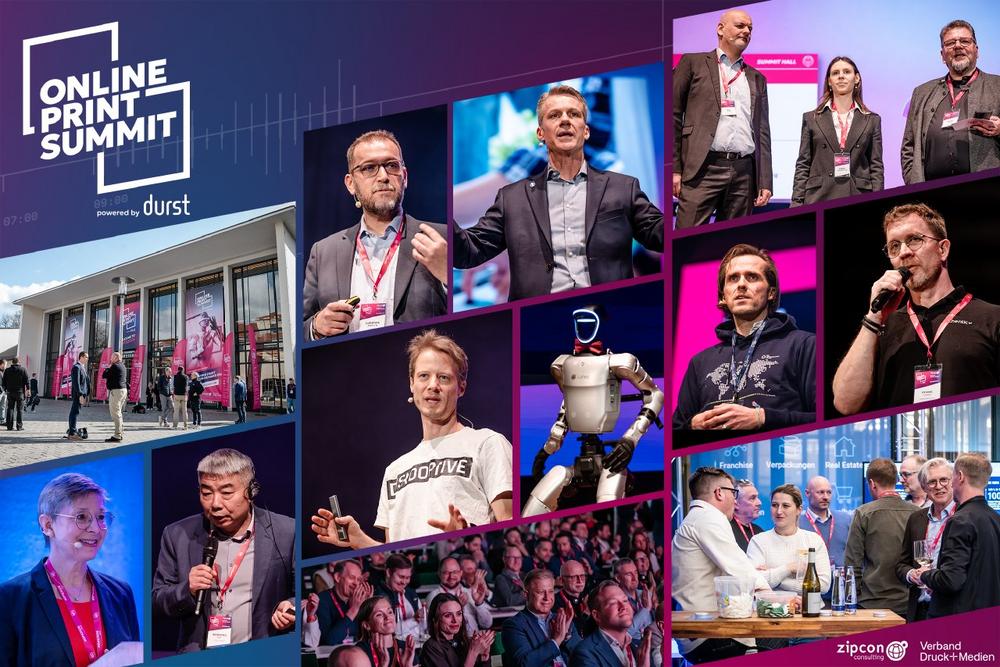
Over the two days of the event, three keynote speakers, 20 presenters, four start-ups, as well as five C-Level Classrooms and Executive Briefings provided exciting insights into their business models. The Online Print Summit (OPS) 2026 made it clear that the industry is not only continuing to evolve step by step as it has in the past but is also fundamentally reorganizing itself. What in previous years was often a question of technical implementation is increasingly becoming a strategic turning point, because business models, forms of visibility, customer journeys, and production logics are changing simultaneously. The record participation of 350 guests and the growing international presence both on stage and in the audience demonstrated that these developments must now be viewed within a global competitive and innovation environment.
From Optimization to Rethinking
Against this background, the Online Print Summit (OPS) 2026 was more than an overview of current trends. It represented a working status of the future. Many presentations and discussions revolved around the same insight: it is no longer sufficient to simply make existing online print models more efficient. The industry must redefine its role within a changing e-commerce reality. Artificial Intelligence is not only transforming content and processes, but also the ways in which products are discovered, compared, and purchased. As customer interaction increasingly shifts from traditional search toward AI agents, the rules for shops, consulting, and fulfilment will also change.
AI, Agentic Commerce, and Hyper-Personalization Move to the Center
A strong impulse came right at the beginning from Ruppert Bodmeier, CEO and co-founder of disrooptive.com, with his analysis of the AI-driven transformation of e-commerce. His core message: the “AI readiness phase” is coming to an end, and the “AI build phase” is beginning. Companies that now boldly develop new skills, workflows, and solutions can secure clear competitive advantages. This perspective ran through numerous contributions at OPS and condensed into the question of how “agent-ready” online print already is.
Bernd Zipper, founder and CEO of zipcon consulting and co-organizer of the Online Print Summit, continued this line of thought in his keynote and gave participants concrete recommendations for action. Online print as a central innovation driver of the print industry must combine trust and authenticity with technological openness and actively shape the transformation itself before other market participants assume this role. “The industry must now do its homework: structure data properly, create its own standards, and become agent-ready. We must shape the transformation ourselves before others do it for us,” Zipper appealed.
More Courage, a New Relevance of Print, and New Access to the Market
That this development should not be interpreted as a threat but as a change in direction was also emphasized by Philipp Mühlbauer, co-founder and co-CEO of The Customization Group. He combined the success story of his company with to take more risks, while knowing that this also means accepting the possibility of failure.
That print can gain new relevance in an overstimulated digital world was explained by Ludovic Martin, Web2Print consultant and publisher of the blog print.watch, in his keynote. His thesis: digitalization has already reached its peak, and the desire for print products as a tactile experience and as a trust-building medium is increasing, even among Gen Z. However, the task of established online printers must be to actively bridge the gap between the analogue and digital worlds through a repositioning within the rapidly changing print ecosystem. Martin combined this statement with the prediction that we are moving toward a front store-dominated world in which “headless commerce” will increase and continue to accelerate. The resulting task is to adapt shops, systems, and strategies quickly to these changes.
Janneke Klasen, CEO of Schmidt Werbeverpackungen GmbH, demonstrated with refreshing candor that this task is achievable even for a small family-owned business. The innovative use of social media, the bold expansion of networks, and the targeted development of her online presence form the foundation for greater reach, better understanding of target groups, and more individualized customer relationships.
International Exchange Becomes a Competitive Advantage
Just how international the Online Print Summit (OPS) has become was particularly evident in 2026. The speaker line-up clearly reflected the growing international orientation of the event. Perspectives from different markets and social frameworks met on stage. Contributions from Europe, the United States, Brazil, and China showed that many challenges are similar, but that the answers differ significantly depending on the market. This comparison of market logics and growth strategies gave the summit particular depth. The Online Print Summit is increasingly developing into a place where the players in the print industry not only present their positions but also contextualize and refine them within an international framework.
Marcelo Schroeder Isleb, CEO of Digipix, used the Brazilian market as an example to demonstrate how print-on-demand and personalized offerings are gaining increasing importance. Growth is created there primarily through a broad product portfolio, strong brand loyalty, recurring purchases, and a customer experience consistently aligned with user needs. His conclusion: anyone who wants to succeed in this market must use AI strategically, think about processes comprehensively, and understand packaging, logistics, and customer experience as part of the business model.
Cui Wen Feng, CEO and owner of Grand Printing Group, and his son Zhicheng Cui, Vice President of Grandprint, demonstrated how strongly the Chinese print market differs from the European market in structure and dynamics. While specialization, differentiation, and smaller runs often dominate in Europe, Grandprint’s growth strategy is based more strongly on standardization, bundling, high speed, and the scaling of large order volumes. At the same time, it became clear that topics such as personalization, packaging, and AI are also gaining importance in China, albeit under different market conditions and on a much larger industrial scale.
Rusty Pepper, Head of Global Markets & Partnerships at Taylor Corporation, made it clear from a US perspective that it is not the printing production itself but rather missing connectivity and slow processes that represent the greatest obstacles to success in print marketing today. His core thesis: print will only remain relevant if it integrates into connected, data-driven, and fast on-demand fulfilment structures, reduces friction losses, and makes its contribution to marketing impact and performance measurable. It will therefore be crucial to move beyond looking only at cost per unit and instead focus on metrics such as speed, time-to-market, or return on impression.
These are KPIs that have long been part of everyday practice for Michał Tracz, CEO of Print Logistic. Using the example of his home market of Poland, he demonstrated how print-on-demand has evolved from a supplementary business model into an industrially scalable production logic. According to his analysis, the market has entered a phase of consolidation and professionalization following the special economic effects during the COVID period. Anyone who wants to succeed in the POD business today needs not only capacity, but above all reliable quality, fast delivery times, and robust fulfilment structures. At the same time, Tracz referred to the growing importance of social commerce, influencer-driven ordering patterns, and AI-supported processes. His conclusion: in the future, online print will no longer be decided solely by price and production performance, but by the ability to process highly variable orders quickly and reliably within connected platform and logistics structures.
Humanoid Robots in Print Production – and on the OPS Stage
How far technological transformation now extends beyond traditional automation was also demonstrated by Enes Ciritci, Managing Director of Lunes Robotics, in his closing address on humanoid robots as future production partners.
His presentation focused less on the spectacular machine itself and more on its practical value: in times of skilled labour shortages, increasing efficiency pressure, and high requirements for process stability, humanoid robotic systems could become particularly important wherever monotonous, physically demanding, or unattractive tasks must be performed reliably.
For the print industry, Ciritci already sees concrete areas of application today, for example in material transport, pallet handling, or waste disposal. The key, he explained, is to understand robotics not as a distant future scenario but as an integrable, software-supported extension of real production environments. To support his thesis, Ciritci also brought assistance onto the stage, namely the humanoid robot Luna, which had already been walking around the Online Print Summit throughout the event and attracted considerable attention.
Practical Relevance Instead of Trend Folklore
The fact that the Online Print Summit (OPS) 2026 remained closely attuned to the real-world challenges facing companies, despite its strategic depth, was also evident in the new dialogue formats of the C-Level Classrooms and Executive Briefings. These were specifically designed not only to introduce topics but to translate them into smaller, more in-depth formats.
- Beatrice Klose, Secretary General of INTERGRAF, guided participants through EU legislation and its impact on the print industry,
- Christian Harder of Durst Group explained the next stage of print production from the perspective of a hardware and software provider,
- Marc Horriar of Cloudlab presented the Web2Print provider of the future,
- Marc Hunsäger of Koenig & Bauer spoke about brand and product protection,
- Thomas Karcher of Butz & Bürker highlighted the importance of no-code solutions for the print industry,
- Ludovic Martin outlined the challenges of establishing chatbots,
- Axel Zöller of Heidelberger Druckmaschinen provided insight into AI-based workflow automation,
- Stefan Lutz from Lunes Robotics spoke about the potential of humanoid robots in print production,
- Rainer Prosi of CIP4 demonstrated the advantages of CIP4 standards for scalable online print, and
- Christoph Clermont of Printess presented tips for achieving strong customer loyalty through improved user experience.
Start-ups Set the Pace for Innovation
Fresh perspectives on the online print industry, its products, and business models were once again brought to the stage this year by the Insight Pitches. Four start-ups from Germany, the United States, Serbia, and Italy demonstrated that print innovation in the AI era no longer arises solely from hardware and production speed.
The participants were:
- Frank Theeg of authentic.network, who is revolutionizing anti-counterfeiting with printable blockchain technology,
- Luka Filipović of Dynamic Mockups, who is taking AI-supported image generation to a new level,
- Nick Gawreluk of Print Profit, a software offering that increases strategic thinking and company profitability through data-based insights, and
- Gian Luigi Bacchi of Revibes, who connects the analogue and digital worlds with augmented photo products in order to create lasting memories for customers.
In addition to the start-ups, Sarah Schumacher also brought new perspectives and thought-provoking questions about innovation, transformation, and entrepreneurial thinking. The student, who was recognized by INTERGRAF for her achievements and is currently completing her Master’s degree in Entrepreneurship & Innovation in Sweden, embodied the dialogue between established decision-makers and a generation that sees change as an opportunity.
The Organizers Are More Than Satisfied
“The Online Print Summit 2026 clearly showed that online print is entering a new era,” says Bernd Zipper, founder and CEO of zipcon consulting and co-organizer of the Online Print Summit. “AI, Agentic Commerce, and hyper-personalization are not only changing tools, but the mechanics of the market itself. The course is being set now: the winners will be those who further develop their business models so that print remains visible, relevant, and economically strong within the new value chains.”
Jens Meyer, CEO of Verband Druck und Medien Beratung and co-organizer of the Online Print Summit, also draws a clear conclusion: “The record attendance of 350 and the distinctly international focus of the OPS demonstrate that the need for context, exchange, and strategic orientation continues to grow. Online print is no longer only discussing efficiency gains within existing structures. It is working to define its place in a new reality of commerce and communication.”
More About the Online Print Summit 2026 – and the Date for 2027
Impressions from the Online Print Summit 2026 will be available on the OPS website over the coming days. Articles about individual presentations will follow in the coming weeks on beyond-print.de.
Anyone who would like to experience the Online Print Summit live should already mark the date for 2027 in their calendar: OPS 2027 will take place again in Munich on 13 and 14 April 2027. Tickets are now available for purchase at the early-bird price via the OPS website.
The organisers
zipcon consulting GmbH is a global consulting company for the communications, print and media industry with a focus on online print and digital transformation. The company sees itself as an independent and comprehensive technology and strategy consultant. zipcon also produces market studies and various case studies for e-business print, mass customization and multichannel publishing. Leading companies in the online print industry rely on the expertise of this company. www.zipcon.de
Verband Druck und Medien Beratung GmbH is the consulting company of the Printing and Media Associations. With in-depth industry expertise in management, controlling, environmental issues, sustainability, as well as production and processes, it supports the industry and positions itself as a driver of innovation and business success. Backed by the regional associations and the German Printing and Media Industries Federation, it consolidates expertise and future perspectives for the industry under the umbrella brand “Verband Druck und Medien.” www.vdm-beratung.de
Der Online Print Summit – vormals Online Print Symposium – ist ein jährlich stattfindendes Event für die Onlineprint-Industrie. Seit 2013 bieten die Veranstalter zipcon consulting GmbH und Verband Druck und Medien Beratung GmbH das Symposium in München an. Mit etwa 300 internationalen Besuchern, einer Partnerausstellung, Abendevents und zwei Tagen mit hochkarätigen Vorträgen hat sich das Online Print Symposium (OPS) zum wichtigsten Event der Branche entwickelt. Am 12. und 13. März 2026 findet der OPS unter dem Motto „Re:Inventing Print for the On-Demand Era“ in der Alten Kongresshalle München statt.
Online Print Summit c/o zipcon consulting GmbH
Am Buchenhain 4
45239 Essen
Telefon: +49 (201) 81175-0
https://www.online-print-summit.com
Telefon: 089 – 330 36 210
E-Mail: j.meyer@vdm-beratung.de
E-Mail: zz@zipcon.de
