
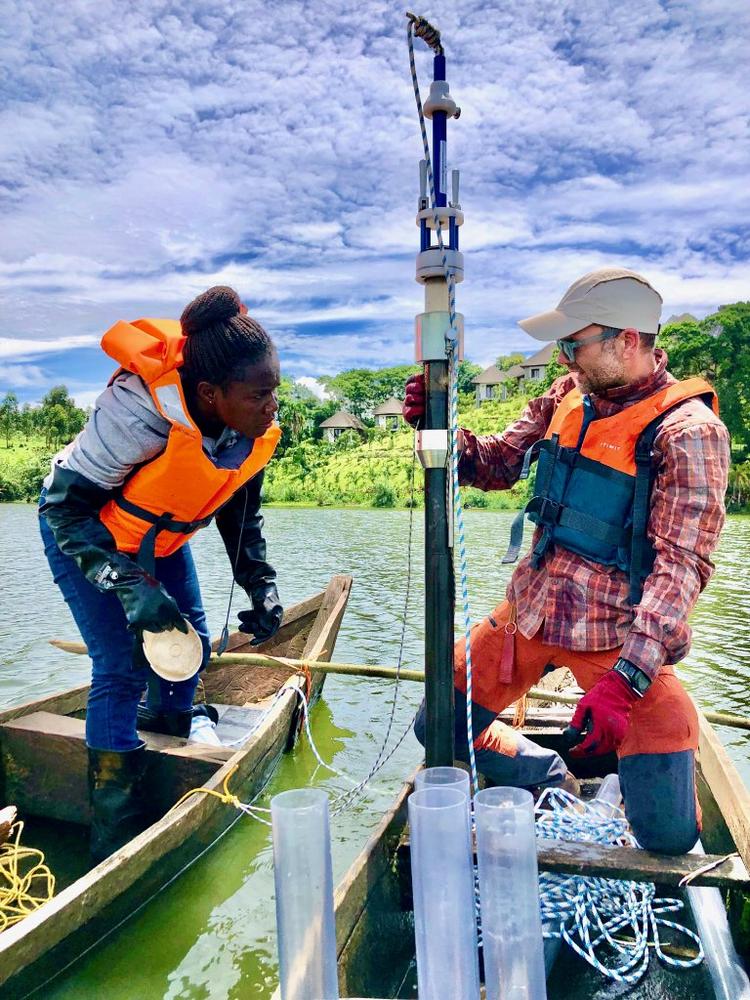
Tropical and subtropical regions are home to the world’s most species-rich ecosystems: 80 percent of global biodiversity hotspots and over half of all endangered animal and plant species can be found in these areas. “Our own history is also closely linked to the tropics. Around 300,000 years ago, modern humans, Homo sapiens sapiens, emerged in tropical Africa, subsequently spreading from there across the entire globe. Today, over 41 percent of the world’s population lives in the tropics and subtropics,” says the study’s lead author, Prof. Dr. Miklós Bálint from the Senckenberg Biodiversity and Climate Research Center and Justus Liebig University Giessen, and he continues, “Nevertheless, a crucial tool for exploring these regions has long been missing – and that is ancient environmental DNA.”
Ancient environmental DNA (aeDNA) refers to DNA fragments that have been preserved in the environment over long periods of time and originate from plants, animals, microorganisms, or humans. It is not extracted directly from an organism but from soil, sediments, water, ice, or permafrost samples. The prevailing scientific consensus was that heat and humidity degrade genetic material too quickly in the tropics and subtropics to work with aeDNA. Therefore, the majority of analyses of ancient DNA traces focused on cold, dry regions of Europe, North America, Asia, and the Arctic. “However, we have ignored the biological history of the Earth’s major ecosystems based on an assumption that turns out to be only partially true,” explains Bálint. “Our new findings show that ancient environmental DNA in the tropics and subtropics can survive for surprisingly long periods of time if we look in the right places, such as lake sediments or low-oxygen swamps.”
Dr. Justine Nakintu from Mbarara University of Science and Technology and Soroti University in Uganda explains, “In our study, we present several impressive examples of what these genetic ‘time machines’ can reveal.” The study’s first author conducted her research between May and July 2025 during her Senckenberg Global Fellowship in Frankfurt. “In Lake Towuti in Indonesia, for example, researchers discovered DNA from plants that are up to one million years old. In other regions, aeDNA was used to trace the spread of agriculture 5,300 years ago, and even the history of pathogens,” says Nakintu.
In Mexico, for instance, aeDNA from human bones revealed that syphilis was present in the country during the 17th and 19th centuries. In addition, Salmonella enterica bacteria were identified as the cause of the “Cocolitzli” epidemic in Mexico in the 16th century. In the future, aeDNA could also clarify whether epidemics were responsible for the sudden collapse of human populations in Central Africa between 400 and 600 AD, according to the study.
“Moreover, this approach enables a more precise reconstruction of the origins and subsequent evolution of human history. A human being has a maximum of 210 bones and 32 teeth, most of which will never be preserved as fossils. However, this person produces millions of DNA traces during their lifetime, which are far more likely to be left behind in the environment,” adds Bálint. Nakintu continues, “This tool also allows us to see how tropical species reacted to climate change in the past – which in turn provides crucial information for their protection in the future. We can now reconstruct entire communities of plants and animals from a single teaspoon of mud without the need to unearth rare fossils.”
Although most of the world’s biodiversity is found in the tropics, the majority of ancient environmental DNA laboratories are located in Europe, North America, and Asia. The authors emphasize that bridging this geographical divide offers a unique opportunity to increase the quality of scientific research on a “glocal” level. The establishment of collaborations, laboratories, and training programs in tropical countries enables faster analyses and, most importantly, deeper insights. “If we really want to understand tropical biodiversity, we need to export knowledge, not just samples,” emphasizes Nakintu, and she summarizes, “This approach transforms scientific research into a mutually beneficial partnership. It expands global research capacities, diversifies researchers’ questions, and ensures that the history of these important ecosystems is reconstructed by the people who live with them.”
The study is a result of the “Senckenberg with Africa” initiative, which promotes equitable cooperation between German and African researchers.
Senckenberg – Leibniz Institution for Biodiversity and Earth System Research // Senckenberg Gesellschaft für Naturforschung
Senckenberganlage 25
60325 Frankfurt
Telefon: +49 (69) 7542-0
Telefax: +49 (69) 746238
http://www.senckenberg.de
Senckenberg Biodiversitäts- und Klima Forschungszentrum Frankfurt
E-Mail: miklos.balint@senckenberg.de
Mbarara University of Science and Technology, P.O Box 1410, Mbarara, Uganda
E-Mail: jnakintu@must.ac.ug
Leitung Pressestelle & Social Media
Telefon: 06975421434
E-Mail: judith.joerdens@senckenberg.de
