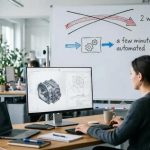
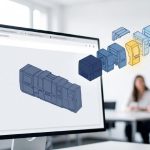
Process Automation in Mechanical Engineering: How Companies Are Removing Manual Routine from Design

A customer requests a custom variant, sales commits to a delivery date, and the design department begins the search for the right CAD model. Weeks pass before the drawing and bill of materials are finished, because every variant is adapted Mehr

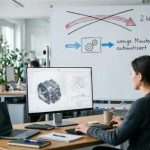
Prozessautomation im Maschinenbau: Wie Unternehmen manuelle Routine aus der Konstruktion nehmen

Ein Kunde fragt eine Sonderausführung an, der Vertrieb sagt einen Liefertermin zu, und in der Konstruktion beginnt die Suche nach dem passenden CAD-Modell. Wochen vergehen, bis Zeichnung und Stückliste fertig sind, weil jede Variante von Hand angepasst wird. Dieses Szenario Mehr

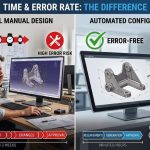
System Integration: The Difference Between Point Solutions and End-to-End Continuity

Manufacturing companies invest millions in CAD systems, PDM platforms, and ERP software. And yet an engineer still transfers part numbers and bills of materials by hand from one system to another. This is not an isolated case. It is standard Mehr

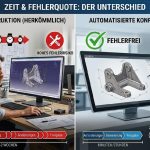
Systemintegration: Der Unterschied zwischen Insellösung und Durchgängigkeit

Maschinenbauunternehmen investieren Millionen in CAD-Systeme, PDM-Plattformen und ERP-Software. Und dann überträgt ein Konstrukteur Artikelnummern und Stücklisten per Hand von einem System ins andere. Das ist kein Einzelfall. Das ist Standard in einem Großteil der deutschen Maschinenbaubranche, und es kostet mehr Mehr

Engineering Automation: How Mechanical and Plant Engineers Seamlessly Connect Sales, Engineering, and Manufacturing

  Manual Handoffs Cost More Than Engineering Hours Organizations in mechanical and plant engineering that deal daily with the same product data being maintained separately across CAD, PDM, ERP, and CRM systems know the consequences: errors that propagate through the Mehr

Engineering Automation: Wie Maschinen- und Anlagenbauer Vertrieb, Konstruktion und Fertigung durchgängig verbinden

  Manuelle Übergaben kosten mehr als Ingenieursstunden Wer im Maschinen- oder Anlagenbau täglich erlebt, wie dieselben Produktdaten in CAD, PDM, ERP und CRM separat gepflegt werden, kennt das Ergebnis: Fehler, die sich durch die gesamte Auftragsabwicklung ziehen und Konstrukteure, die Mehr

Wer Anlagen noch als 2D-Skizze plant, riskiert den Auftrag!

Trotzdem liefern viele Unternehmen ihren Kunden bis heute abstrakte 2D-Grundrisse, die weder Höhen noch Kollisionen abbilden. Das ist kein Ausdruck von Sparsamkeit. Es ist ein struktureller Wettbewerbsnachteil – und er ist behebbar. Das 2D-Problem ist kein Detailproblem Wer ein Anlagenlayout Mehr

Still Planning Facility Layouts on 2D Floor Plans? You Are Risking the Contract.

Yet many companies still deliver abstract 2D floor plans to their customers — plans that capture neither heights nor potential collisions. This is not an expression of efficiency. It is a structural competitive disadvantage — and it is fixable. The Mehr

Drei Tage für eine Variante, die sich hätte automatisieren lassen: Warum manuelle Konstruktionsprozesse heute keine Option mehr sind

  Das Problem hat einen Namen: repetitive Expertise Im Sondermaschinenbau, im Anlagenbau, überall dort, wo Kunden konfigurierbare Produkte bestellen, läuft täglich dasselbe Muster ab. Ein Ingenieur mit fünf oder zehn Jahren CAD-Erfahrung öffnet Autodesk Inventor, zieht Maße aus der Anforderungsliste, Mehr

Three days to build a variant that a rule set could have generated in minutes. Why manual design processes are no longer defensible

  The problem has a name: repetitive expertise In special-purpose machinery, in plant engineering, wherever customers order configurable products, the same pattern plays out every day. An engineer with five or ten years of CAD experience opens Autodesk Inventor, reads Mehr